A Shared Vision
  • Home
  • Página principal
  • Refer a Child
    • Refer a Child
    • Frequently Asked Questions
  • Remitir a un niño
    • Remitir a un niño
    • Preguntas mas frecuentes
  • Stay Informed
    • Latest News
    • Newsletters
    • Annual & Financial Reports
  • Manténgase informado
    • Últimas noticias
    • Boletines
  • Parent Resources
    • Parent Resources Introduction
    • Let's Play!
    • Learning Experiences© >
      • Learning Experiences©
      • Expanded Core Curriculum
    • Sensory Recipes >
      • Sensory Recipes Introduction
      • Sensory Recipes
    • Gift Ideas
    • Digital Resources >
      • Digital Resources Overview
      • Active Learning
      • Building Communication Skills
      • CVI
      • Dual Sensory Loss
      • Early Emergent Literacy
      • Eye Conditions
      • Eye Glasses for Your Child
      • Feeding
      • Meeting with Your Ophthalmologist
      • Orientation & Mobility
      • Patching for Your Child
      • Routines
      • Sleep
      • Strategies
      • Tactile Skills
      • Transition to Preschool
    • Other Great Organizations
  • Recursos para padres
    • Recursos para padres
    • A jugar!
    • Experiencias de aprendizaje© >
      • Experiencias de aprendizaje©
      • Currículo Básico Expandido
    • Recetas sensoriales© >
      • Recetas Sensoriales© introducción
      • Recetas sensoriales©
    • Ideas para regalar
    • Recursos digitales >
      • Recursos digitales
      • Afecciones oculares
      • Gafas para su hijo
      • Habilidades alimentarias
      • Reunión con su oftalmólogo
      • Estrategias
      • Transición al preescolar
  • For Our Families
    • Welcome New Families
    • Top digital resources for new families
    • Inspiring Families
    • Esmeralda's Day
  • Para nuestras familias
    • Bienvenida a las nuevas familias
    • Nuestros recursos favoritos
  • Vision Screening
    • Importance of Vision Screening
    • Protocol & Resources
    • Quickstart Guide
    • Vision Screening Training
    • Directory Pediatric Eye Doctors
    • Links & Documents >
      • Links
      • Email & Text Templates
      • PDF Documents
    • Information For Pediatric Eye Doctors
    • Well-Child Vision Screening for CVI
  • Donate Now
    • Donate Now
    • Value of Early Intervention
    • CO Child Care Tax Credit
  • Donar ahora
    • Donar ahora
    • El valor de la intervención precoz
  • Trainings & Education
    • Trainings & Education
  • About Us
    • Our Mission, Goal, Values
    • What We Do
    • Our Team
    • Our Board
    • Our Partners
  • Quiénes somos
    • Nuestra misión, objetivo y valores
    • Qué hacemos
    • Nuestro equipo
  • Contact Us
  • Contáctese con nosotros
Learning Experiences©

Little One, Little One, What Do You See?

Little One, Little One, What Do You See?

Many children with visual impairments have difficulty seeing at a distance. Let’s explore what your child can see at a distance. What size of object and at what distance can your child see? What are the details your child can see at a distance?

We can try to make it easier for your child to look at something in the distance by using specific, direct strategies. Your child may see better or worse in different environments depending on the lighting, contrast, other distractions, and familiarity with what they are looking for.
PDF English
For EI-TVI

Duration

This activity will take 5 to 10 minutes depending on your child’s interest and your family’s needs.

Materials Required

Objects in the child’s natural environment, such as your child’s bottle or favorite toys, as well as some unfamiliar objects that are part of their home environment.

Activity Steps

  1. Has your child been to the eye doctor? What is the diagnosis? What are the implications for distance vision? Talk about the diagnosis with your Early Intervention Teacher of the Visually Impaired (EI-TVI). What are some strategies you’ve learned from your EI-TVI?
  2. Does your child wear glasses? Are the glasses prescribed for near or distance vision? Are they supposed to be worn all the time or specific times during the day? Talk about why and when your child wears their glasses with your EI TVI. Does your child like to wear their glasses?
  3. How far away do you think your child can see their favorite ball or truck? Place the toy in the room where it is usually kept at that distance, such as on a shelf or in a toy bin.
  4. Say, “Let’s go play with your red truck or bouncy ball.” Use a toy that will move. It’s important to go get toys or objects together rather than you bringing them to the child so that the child can learn where things are kept and eventually be independent with getting them and putting them away.
  5. If they can move independently toward the toy, watch for the moment when the child sees the object. How far were they from the object? If they can’t move independently, move them toward the object very slowly and note the moment you see the child’s eyes focus on the object.
  6. Play with the object after the child finds it. Notice the distance at which the child looks for the ball or truck as you play. Encourage back-and-forth play.
  7. Talk about the toy’s attributes. What is the shape and color of the ball or truck? These attributes are called “salient features” and will help the child identify and find objects. Things at a distance will be blurry to your child, but the shapes and colors will be there. They just won’t be clear. Take a minute to show your child what is in the distance by verbally describing it and moving closer and touching it. You can also take a picture of it and then enlarge it on your phone or iPad so that the child can see a close-up view of what is at a distance.
  8. After you’ve played a few minutes, say, “I’m going to put it away and then you can go get it AGAIN. Yay!” Put the toy away in the same spot and see if the child can see it at the same distance or a little further away.
  9. Say, “Go find your truck!” Teach your child to move closer to the truck if they don’t see it.
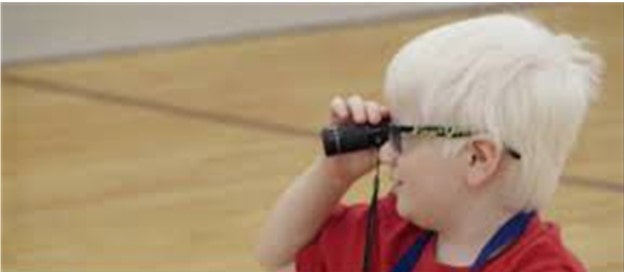
  10. For some children, you won’t be able to teach them to see at a distance because of their diagnosis, so you need to teach them to compensate with other skills. They need to move closer or use a monocular. You can also use an iPad or phone to take a picture of something in the distance and then make it bigger on the iPad or phone for the child to see. Eventually, you can teach the child to use the iPad or phone independently.
Picture

Tips

  • You can make it easier for your child to find objects by reducing the number of objects (reduce visual clutter) around the one your child is looking for. Start by just looking for one object all by itself.
  • You can alter the lighting to help your child. Depending on your child’s eye condition, low lighting or bright lighting might help. Don’t put the object under or beside a window if your child is sensitive to light or is attracted to light. Experiment by turning off and on the light to see which lighting condition is most helpful.
  • You can make it easier for your child to see if you add a contrasting background. It will be easier to see a red ball against a white wall or a white floor rather than red carpet.
  • You can make it easier for your child to see if you make the target bigger. For example, use a bigger ball.
  • You might make it easier for your child to see if you use movement as a cue.
  • Observation is the key. Watch your child to see when they lose interest. This could mean that they can no longer see the toy.
  • Try not to use sound. We want to notice what your child can see at a distance without using sound as a cue.

Extension Activities

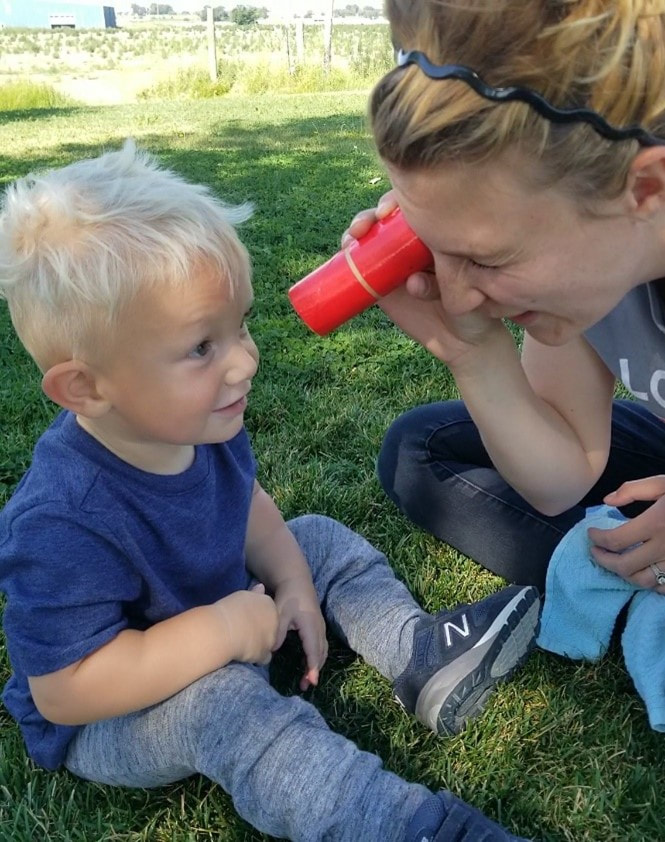
  • Try this activity outside in the backyard or at a park. What can your child see at a distance when they are outside? Lighting will greatly affect your child’s ability to see. Do they need sunglasses or a hat? What tips will you use to help your child find something at a distance when outside?
  • Play “Hide the Object” and see what distance your child can find it and under which conditions. You can also play “Hide and Seek” and see if your child can find you or another familiar person.
  • Set up your natural environment into an obstacle course. Climb over the cushion, go under the table, go around the sofa, step in and out of the wading pool, etc.
  • Experiment with binoculars. Model using them.
  • Read the book Brown Bear, Brown Bear, What Do You See? by Bill Martin, Jr. Talk about what you see in the book. Relate it to what your child can see as they look around.
  • When you go to a zoo or an event where you’re looking at objects from a distance, bring your phone or your iPad so you can take pictures. At the zoo, for example, photograph the animals, enlarge the photos with the zoom feature, and show the animals to your child close up with your iPad or phone.
  • Make an experience book about some of the objects you saw during that day with your child.
Picture
HOME (Mapa del sitio en español)
REFER A CHILD
Refer a Child

Frequently Asked Questions
STAY INFORMED
Latest News

Newsletters
Annual & Final Reports
PARENT RESOURCES
Introduction
Let's Play
Learning Experiences©
Sensory Recipes
Gift Ideas
Digital Resources
Other Great Organizations
FOR OUR FAMILIES
Welcome New Families

Top Digital Resources For New Families
Inspiring Families
Esmeralda's Day
VISION SCREENING
Importance of Vision Screening
Protocol & Resources
Quickstart Guide
Vision Screening Training
Directory of Pediatric Eye Doctors
Links & Documents
DONATE NOW
Donate Now

Value of Early Intervention
CO Child Care Tax Credit
TRAINING & EDUCATION
Training & Education

ABOUT US
Our Mission, Goal, Values
What We Do
Our Team
Our Board
Our Partners

A Shared Vision: Partners in Pediatric Blindness & Visual Impairment

EIN 81-4227664
Privacy Policy
Certificate of Insurance
  • Home
  • Página principal
  • Refer a Child
    • Refer a Child
    • Frequently Asked Questions
  • Remitir a un niño
    • Remitir a un niño
    • Preguntas mas frecuentes
  • Stay Informed
    • Latest News
    • Newsletters
    • Annual & Financial Reports
  • Manténgase informado
    • Últimas noticias
    • Boletines
  • Parent Resources
    • Parent Resources Introduction
    • Let's Play!
    • Learning Experiences© >
      • Learning Experiences©
      • Expanded Core Curriculum
    • Sensory Recipes >
      • Sensory Recipes Introduction
      • Sensory Recipes
    • Gift Ideas
    • Digital Resources >
      • Digital Resources Overview
      • Active Learning
      • Building Communication Skills
      • CVI
      • Dual Sensory Loss
      • Early Emergent Literacy
      • Eye Conditions
      • Eye Glasses for Your Child
      • Feeding
      • Meeting with Your Ophthalmologist
      • Orientation & Mobility
      • Patching for Your Child
      • Routines
      • Sleep
      • Strategies
      • Tactile Skills
      • Transition to Preschool
    • Other Great Organizations
  • Recursos para padres
    • Recursos para padres
    • A jugar!
    • Experiencias de aprendizaje© >
      • Experiencias de aprendizaje©
      • Currículo Básico Expandido
    • Recetas sensoriales© >
      • Recetas Sensoriales© introducción
      • Recetas sensoriales©
    • Ideas para regalar
    • Recursos digitales >
      • Recursos digitales
      • Afecciones oculares
      • Gafas para su hijo
      • Habilidades alimentarias
      • Reunión con su oftalmólogo
      • Estrategias
      • Transición al preescolar
  • For Our Families
    • Welcome New Families
    • Top digital resources for new families
    • Inspiring Families
    • Esmeralda's Day
  • Para nuestras familias
    • Bienvenida a las nuevas familias
    • Nuestros recursos favoritos
  • Vision Screening
    • Importance of Vision Screening
    • Protocol & Resources
    • Quickstart Guide
    • Vision Screening Training
    • Directory Pediatric Eye Doctors
    • Links & Documents >
      • Links
      • Email & Text Templates
      • PDF Documents
    • Information For Pediatric Eye Doctors
    • Well-Child Vision Screening for CVI
  • Donate Now
    • Donate Now
    • Value of Early Intervention
    • CO Child Care Tax Credit
  • Donar ahora
    • Donar ahora
    • El valor de la intervención precoz
  • Trainings & Education
    • Trainings & Education
  • About Us
    • Our Mission, Goal, Values
    • What We Do
    • Our Team
    • Our Board
    • Our Partners
  • Quiénes somos
    • Nuestra misión, objetivo y valores
    • Qué hacemos
    • Nuestro equipo
  • Contact Us
  • Contáctese con nosotros